


This stopped me in my tracks when I first came across it.
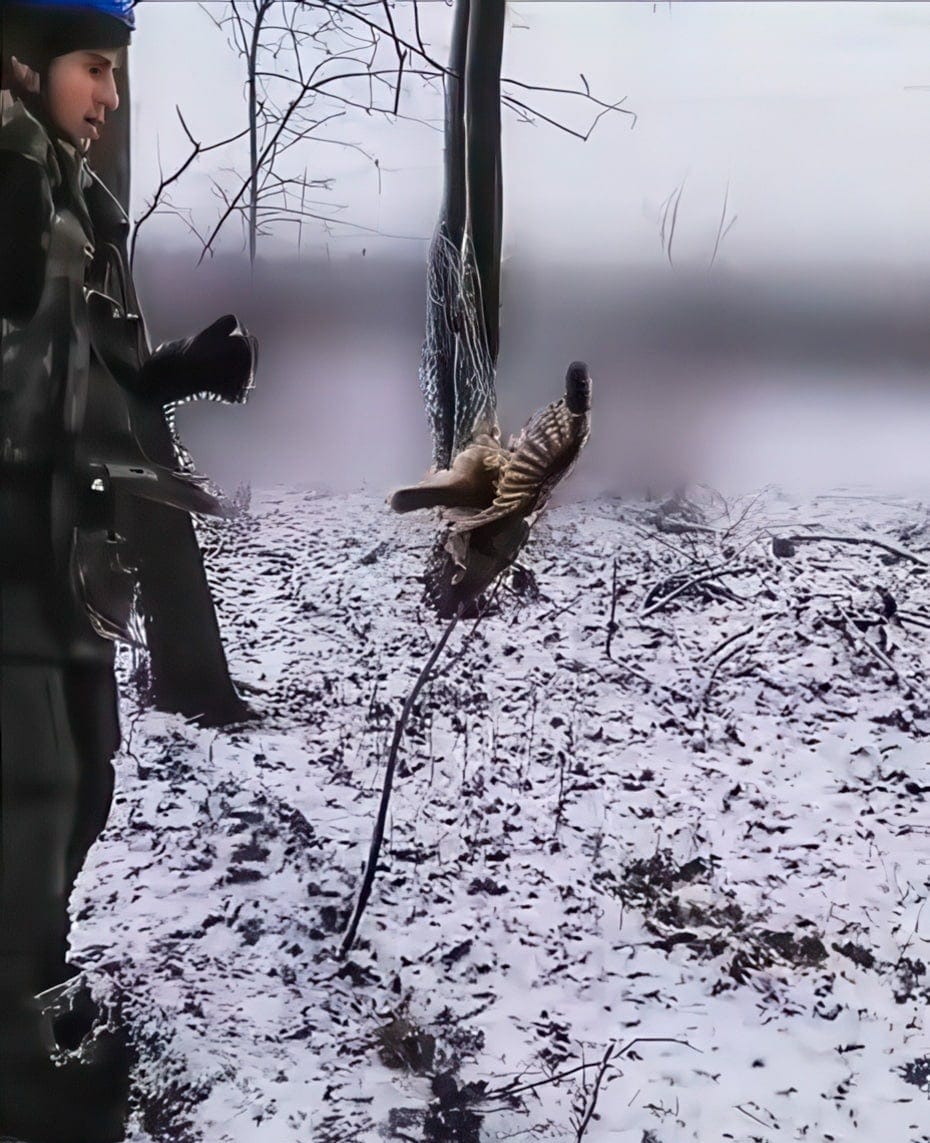
Birds in Ukraine have started building their nests out of fibre optic cable — spooled off the back of drones and left tangled in trees and hedgerows across the front lines.

It sounds almost fanciful, but it isn’t. I think it’s actually a signal — a small, visible symptom of a much bigger and largely unstudied problem spreading across Ukraine’s battlefields.
There are countless kilometres upon kilometres of plastic cable unspooling behind drones every day, settling into fields, forests, and towns, with almost nobody yet able to say what it will do to the land or the animals living there.
This week I want to introduce you to fibre optic FPV drones — how they work, why they’ve become so central to this war, and why the debris they leave behind might be one of the quieter, longer-lasting environmental legacies of the whole conflict.
Spider webs over the battlefield
Soldiers and journalists have started describing entire villages and tree lines as looking like they’ve been wrapped in spider silk.
As these drones race toward their targets, they trail a hair-thin strand of optical fibre behind them, and because so many drones fly so many missions, the accumulated effect is a real physical landscape of thread: glinting in sunlight, snagged on branches, draped over fences and vehicles, settling into farmers’ fields.

DroneXL, reporting on the phenomenon earlier this year, described the result as a landscape that looks like spider silk caught in the sun — striking, but with unknown consequences.
None of this cable is recovered in any organized way. It’s simply left where it falls, mixed in with unexploded ordnance and all the other detritus of modern war.
How these drones actually work
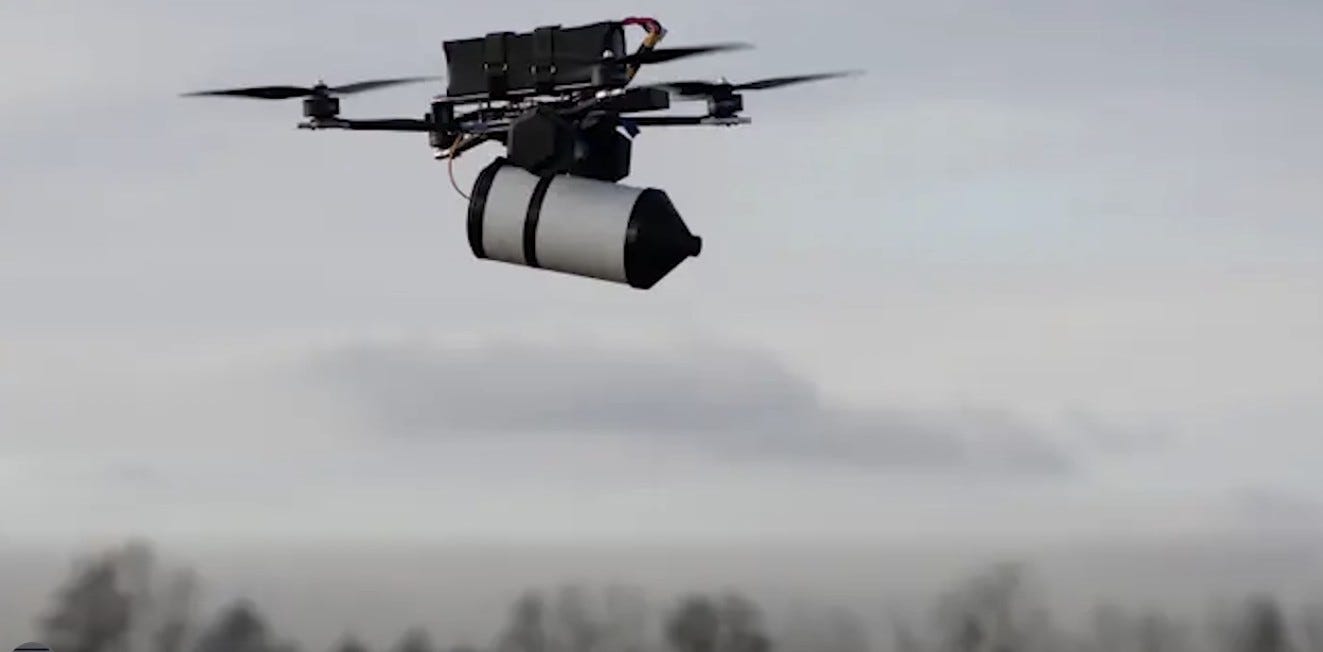
An FPV (first-person-view) drone is flown by an operator wearing video goggles connected to a camera on the drone itself. The pilot effectively “sees” through the machine while hunting for a target to strike with a grenade or explosive charge strapped to the airframe: a building, a vehicle, or a person.
Early in the war, these drones ran on radio signal, which meant they could be jammed by electronic warfare. Fibre optic drones solve that by physically tethering the drone to its operator with a cable — sometimes stretching many kilometres — thinner than ordinary fishing line. No radio signal means nothing for jamming equipment to disrupt, which is why both Russian and Ukrainian forces have raced to adopt the technology.
The environmental question nobody has answered yet
The core of these cables is typically a plastic called PMMA, wrapped in a fluoropolymer cladding — the same broad chemical family as PFAS, the “forever chemicals” now drawing scrutiny elsewhere. Researchers at the Conflict and Environment Observatory (CEOBS) flag overlapping concerns: cables that could persist for hundreds of years, entanglement risks for birds, bats, and ground-dwelling animals, and cables that act like invisible fences cutting off habitat and migration routes.
One researcher who studies the war’s impact on migratory birds told CEOBS these fibre webs will pose a real entanglement danger to threatened species for years to come.
There’s also the question of degradation. Combat zones are hard on plastic, and there’s early evidence that breakdown could release microplastics and, if burned, toxic gases. Batteries from crashed drones add their own contamination risk, one some researchers believe may ultimately outweigh the cable itself, though this too is barely studied.
Then there’s the cleanup problem. Fibre strands tangled through a field make mechanical demining more difficult and dangerous, in a country already facing one of the largest demining efforts in modern history. Nobody planned for a war that leaves behind both explosive remnants and an invisible mesh of plastic threaded through them.
Closer to home
In late May, Canada and Ukraine signed an agreement to manufacture Ukrainian-designed drones on Canadian soil, through a new joint venture called Airlogix-Sentinel, pairing a Ukrainian defence tech firm with Sentinel Research and Development, a Hamilton, Ontario manufacturer.
The initial focus appears to be reconnaissance drones rather than fibre optic FPV strike drones — but given how central fibre optic technology has become to Ukraine’s ability to operate under heavy electronic warfare, a future iteration of this kind of partnership moving in that direction wouldn’t be surprising. Ukraine needs a steady supply of these systems, and manufacturing them somewhere outside the range of Russian strikes on fibre optic plants has an obvious appeal.
A technology whose battlefield debris we don’t yet understand could soon be manufactured, at least in some form, here at home.
If you found this interesting or informative, please like or share.
Leave a comment to explain your vote (paid subscribers)
Last week’s poll
Over the last two weeks we took a close-up view of Prime Minister Carney’s military ambitions for Canada – not just recruiting more soldiers and buying new equipment, but also retooling parts of Canada’s economy to building weapons and selling them on the global market.
I asked you what you thought was the impetus for this massive new expenditure of public dollars on defence.
But counter to a reason often citied on the news, nobody chose the Russian invasion of Ukraine as the main driver.
By far, most people pointed their finger much closer to home: Donald Trump (59%). The rest of the opinions were roughly divided evenly between jobs and the economy (17%), keeping Canada safe (15%), and international obligations and NATO (10%).

Anyone who has even tried to turn a profit on war supplies should be personally liable for ALL clean-up costs, as well as murder charges.