


For decades, Washington danced around the question. This week, it stopped dancing.
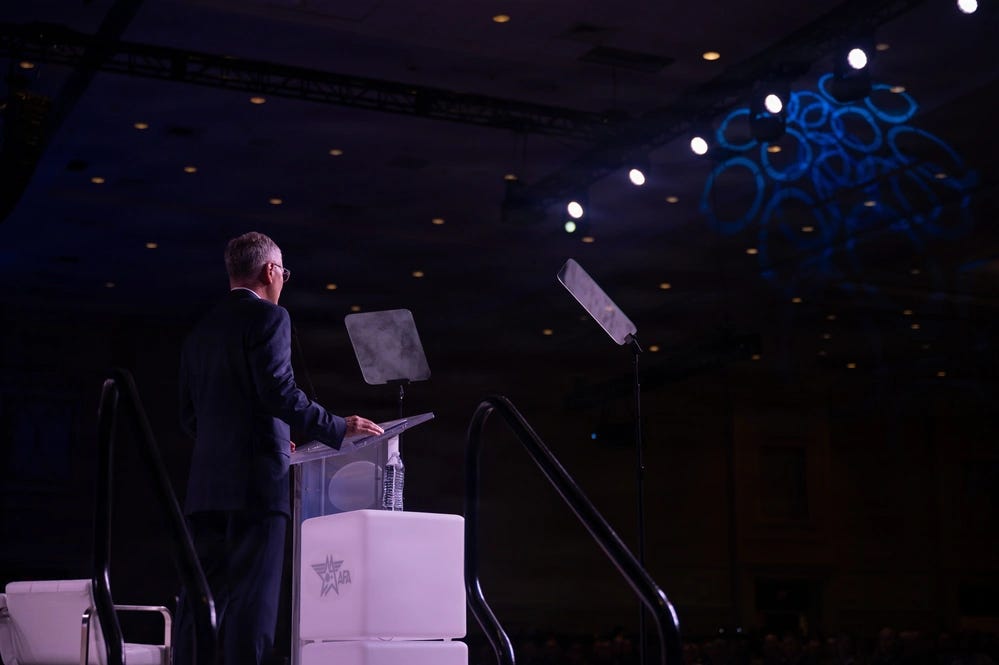
Speaking at the Air & Space Forces Association’s conference in Maryland this week, Air Force Secretary Troy Meink said flatly: “The United States now has on-orbit space control weapons capable of defending the joint force against hostile adversary action.” It was the first time a U.S. official has publicly confirmed that the country has offensive weapons already operating in orbit.
The United States now has on-orbit space control weapons…
U.S. Air Force Secretary Troy Meink
Meink wouldn’t say what the weapons are, how many exist, or when they went up. The Space Force’s own explanation was deliberately vague: “space control” covers kinetic and non-kinetic means to “contest and control” the space domain, from jamming and cyber interference to physically disabling or destroying a satellite.
Analysts suspect the likeliest candidates are non-kinetic — jammers or “inspector” satellites capable of disrupting rivals’ systems — rather than outright satellite-killers, though nobody outside the Pentagon actually knows. The announcement is widely seen as tied to Trump’s “Golden Dome” missile-defence program, which envisions space-based interceptors as its centrepiece.
Reaction from Moscow and Beijing
Both rivals responded fast. China’s foreign ministry spokesman Guo Jiakun urged Washington to “stop expanding its military capabilities and preparing for war in outer space,” warning against an “arms race.” The Kremlin’s Dmitry Peskov said Russia believes “space must be free of any weapon” and called for “broad international consolidation” toward full demilitarization.
A new arms race?
Experts fear this cuts against U.S. interests as much as anyone’s. Victoria Samson of the Secure World Foundation called the admission “huge,” noting the U.S. depends on space more than any rival — and has just handed China and Russia cover to follow suit. Once one power normalizes weapons in orbit, others build to match it, and arms-control talks get harder, not easier. That’s the core of the criticism landing this week: acknowledging the weapons doesn’t deter conflict so much as legitimize the buildup everyone claims to fear.
Canada’s about-face
For over 40 years, Canada said no to this — Brian Mulroney rejected Reagan’s “Star Wars,” Paul Martin rejected Bush’s missile shield in 2005, citing exactly this risk of a space arms race. That political consensus held until this year. When Trump unveiled Golden Dome, Mark Carney signaled Canada wants in. Lloyd Axworthy, Chrétien’s former foreign minister, called it “a betrayal of the vision Canadians voted for.”

What Canada should do next
Canada should say no, as it has twice before. Joining doesn’t buy Canadians control over the system, meaningful protection, or leverage in trade talks — it buys deeper integration into a Pentagon project that most of the world, including our closest allies who happen to be arms-control partners, sees as destabilizing. An independent foreign policy means saying so, publicly, now — before the decision is made by silence.
If you found this interesting or informative, please like or share.
Leave a comment to explain your vote (paid subscribers)
Last week’s readers’ poll
Last week we talked about the first confirmed human deaths from an AI-controlled drone that attacked without a human operator. The drone was launched by Russia in Ukraine. Prime Minister Carney wants Canada to be a world leader for building and exporting drones, where the future of the technology is likely to move in the direction of such independent, AI-controlled weapons. I asked you, “Should we require human control over any weaponized AI drones built in Canada, including those for Ukraine?”
Overwhelmingly, nine in ten readers (91% chose, “Yes, to prevent killer AI drones.” Nearly one in ten said, “Yes, only with an int’l treaty” (7%).

When will we stop destroying our world and all people! The debris of war destroys people our cities and towns, and climate.I am disappointed Prime Minister Carney has substituted Climate change for militarism in all its facets. Space warfare and space junk have the option to sicken the air we breathe and the water and land we need. Immense suffering is with us all! Shame!