

This bizarre F-35 crash is a red flag for Canada
Why is nobody talking about it?

An F-35 crash in Alaska should give shivers to Canada’s military. The pilot survived thankfully, but the $200 million plane was completely destroyed.
Now we know why. And the reason is a warning to Canada’s military pushing to buy a fleet of F-35s.
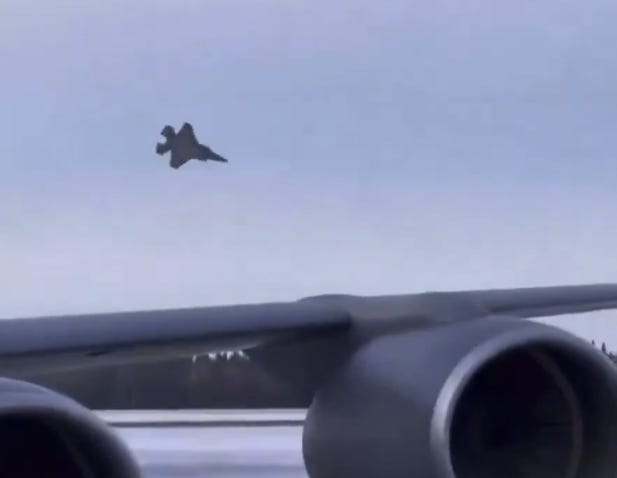
It was late January, 2025 at the U.S. airbase in Fairbanks, Alaska, and four F-35 fighters were preparing for a training flight. It was about lunch time, and the air temperature was -18 Celsius. After a delay caused by – you guessed it – technical problems with the other planes, the four finally were cleared for take-off.
The pilot of the third plane ran into trouble immediately. The front landing gear of the F-35 would not retract fully, jamming at an odd angle. The pilot contacted the ground commander and the other pilots for help.
The pilot tried a number of switches, but the other planes confirmed the landing gear was still jammed. A series of highspeed turns, putting 2.5 times the pressure of gravity on the plane couldn’t shake it loose.
Finally, the commanding officer on the ground decided it was time to call “customer support” at the F-35’s manufacturer: Lockheed Martin.
A conference call was arranged between the F-35 pilot, ground control at the airbase, and 5 engineers working for Lockheed Martin in Texas.
For nearly an hour they painstakingly pored over the warning codes being generated by the aircraft’s complex computers, one by one, as the pilot circled overhead burning precious fuel. They could not figure out the problem.
Finally they decided to perform and incredibly risky maneuver called a touch-and-go.
The pilot approached the runway as if to land, touched the jammed landing gear on the ground to try to snap it into place, then climbed back into the sky. It didn’t work.
On a second try the pilot came in to land at an even higher speed and touched the landing gear on the ground again.
That’s when things went very wrong.
As the pilot pulled up with nose landing gear still jammed, the F-35’s controls went haywire. The plane tilted and dove uncontrollably – the pilot’s joystick stopped working properly, and the plane entered a fatal “stall” position where it can’t remain airborne.
The pilot ejected, and the F-35 dropped like a stone to the ground near the runway, exploding into a ball of flames. The dramatic crash was caught on video by people at the airbase and shared widely over social media.
Incredibly, two weeks later a second F-35 from the same airbase had a similar landing gear problem, but was able to land safely.
What went wrong?
The results of the crash investigation serve as a warning for the Royal Canadian Air Force and its pilots.
Improper handing of hydraulic fluid for the landing gear by U.S. military ground crew allowed water into the mixture, which froze in the sub-zero Alaska temperatures.
The primary cause of the crash was related to operating the F-35 in very cold temperatures, just like Canada’s fleet will have to perform in the North.
Perhaps even worse is that even the U.S. air force was incapable of fixing its complex jet itself, and had to call Lockheed Martin engineers (who still couldn’t fix it).
Oddly, during the 50-minute call the engineers in Texas never asked where the pilot was flying, and didn’t know the F-35 was in Alaska, according to the report.
When the pilot performed the second flyby and touched the ground with the jammed landing gear, the F-35’s complex computer thought the aircraft had actually landed, and switched into a ground-operating mode. “Control of the aircraft was not possible,” said the crash investigation report. The pilot was forced to eject twenty-six seconds later.
Lessons for Canada
Critics of the F-35 for Canada have long pointed out how Canada’s airforce will similarly be unable to maintain its own aircraft, and will be utterly reliant upon the U.S. Lockheed Martin corporation, which is under the control of President Trump.
If Canada goes through on its plan to buy 88 F-35s, will we become completely dependent – and vulnerable – on the United States to use them as we see fit (or not use them)?
The review of the F-35 purchase is overdue
After Trump’s tariffs and take-over threats, the Carney government initiated a review of the deal. Rival Swedish plane-maker Saab offered Canada its Gripen aircraft, which is much better suited to Arctic operations and does not need the Americans. Some have proposed Canada buying F-35s and Gripens, creating a mixed fleet of both aircraft.
Canadian Defence Minister David McGuinty told a Senate defence committee this week that Ottawa has not set a timeline for deciding whether to proceed with its $28 billion plan to acquire 88 F-35A Lightning II fighter jets. So far the government has only paid for 16 F-35s which are being built in Lockheed Martin’s factory in Texas.
If you found this interesting or informative, please like or share.
Leave a comment to explain your vote (paid subscribers)
Readers hopeful Canada will become peace leader, once again
Last week I shared an appeal by prominent Canadians urging the Prime Minister to play a leadership role at the United Nations. Talks happening right now about the global nuclear disarmament agreement, the Nuclear Non-Proliferation Treaty (NPT), are at risk of sinking into disarray, opening the door to an uncertain nuclear future.
By far, most readers agree that Canada can still play a leading role on the global stage (84%). Some said they didn’t know or were unsure (13%), and a handful disagreed (3%).

Any situation that involves dependence on the U.S. must be avoided, for obvious reasons.
Frances Brady
My choice was only to buy Gripens. The chance to not have crashes with F - 35 's is high.
The whole world is in alert. We are promoting PEACE not WAR.