


On Thursday morning in The Hague, the president of the world’s highest court read out a sentence the world court had never pronounced: a country “has committed genocide.”
If you heard the news and assumed the country was Israel, you probably weren’t alone. It was Myanmar.
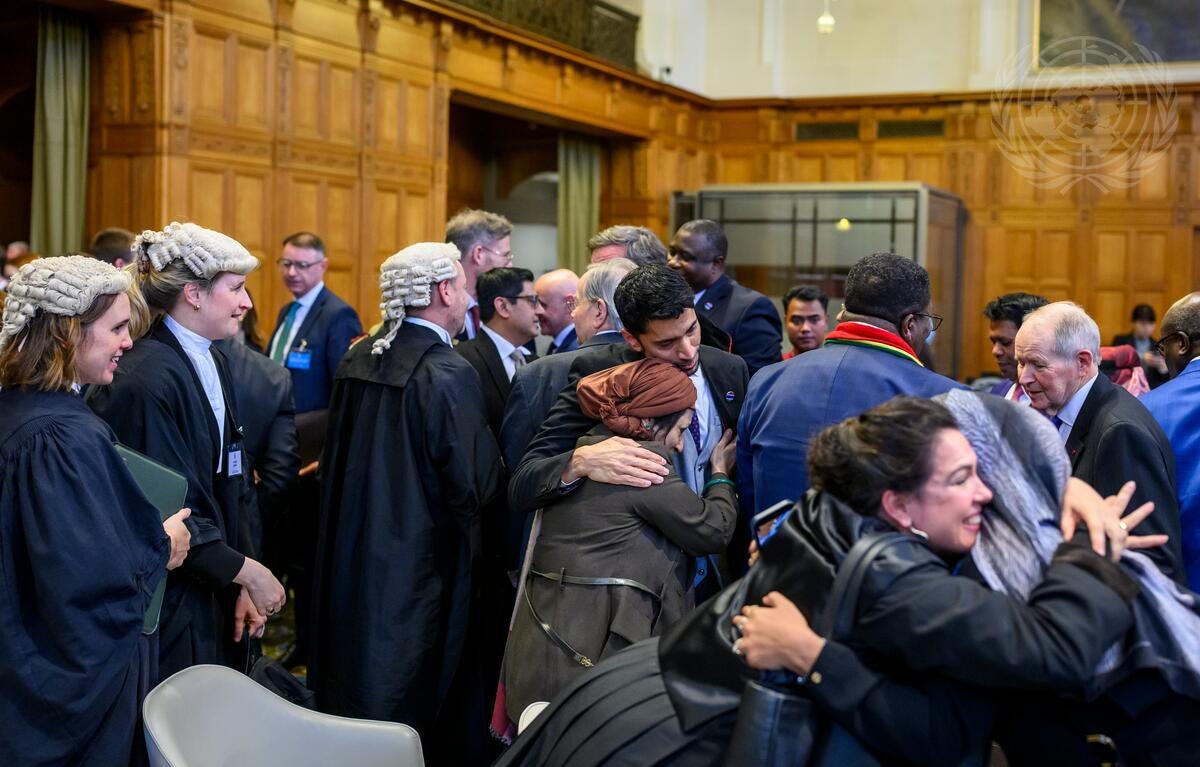
In a 9–6 decision, the International Court of Justice (ICJ) ruled that Myanmar committed genocide against the Rohingya, a mostly Muslim minority, during the military’s 2017 “clearance operation” in Rakhine State. CBC News/AP reports it is the first time the court has found a state, rather than an individual, responsible for genocide.
What did the court find?
Court President Yuji Iwasawa said Myanmar’s security forces “killed thousands of Rohingya civilians, perpetrated widespread acts of sexual violence, as well as acts of extreme violence against children, and attacked fleeing Rohingya.” The court put the death toll at about 10,000. More than 700,000 people fled to Bangladesh, where about 1.2 million Rohingya now live in crowded camps.
The judges rejected Myanmar’s defence that this was a legitimate counter-insurgency operation.
“This is a great day for the Rohingya, and it is a great day for all oppressed people, everywhere.” — Yasmin Ullah, Rohingya rights activist, in the courtroom
UN Secretary-General António Guterres called it a reaffirmation “that impunity for such horrific acts must not stand.” Britain expelled Myanmar’s defence attaché within hours.
Canada has a stake here. In 2018, the House of Commons unanimously recognized the Rohingya atrocities as genocide, and Canada later joined the case as an intervener, alongside the Netherlands and other allies.
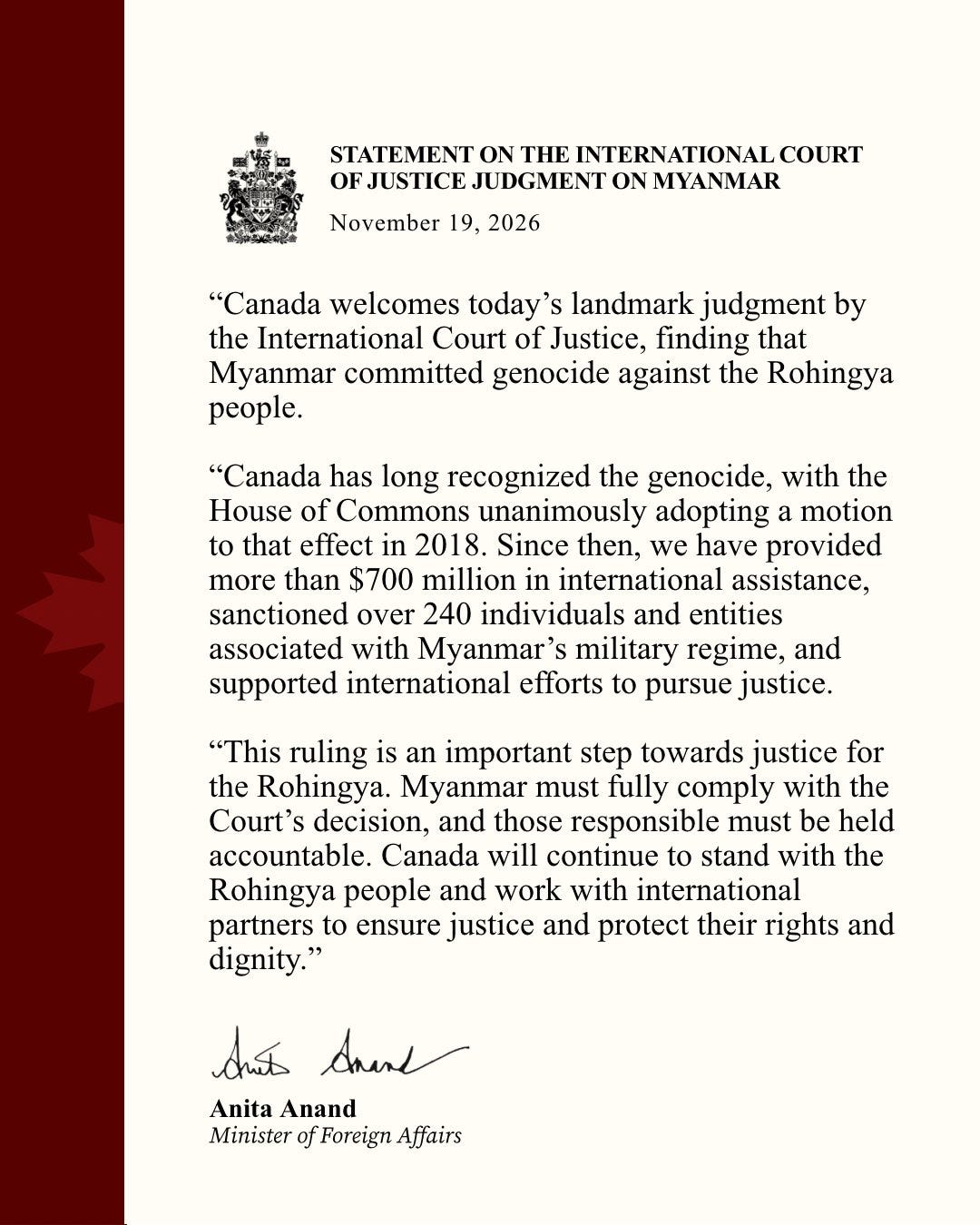
Foreign Affairs Minister Anita Anand welcomed the “landmark judgment” on Thursday, noting that since 2018 Canada has provided more than $700 million in assistance and sanctioned over 240 individuals and entities tied to Myanmar’s military. “Myanmar must fully comply with the Court’s decision, and those responsible must be held accountable,” she said.
Why isn’t every mass killing a genocide?
You might be wondering why other terrible wars aren’t declared genocides, too. For instance, Sudan’s war has killed far more people than died in Rakhine State, yet no court has ruled the war itself a genocide.
That’s because genocide isn’t measured in numbers. Under the 1948 Genocide Convention, it means certain acts (killing, serious harm, conditions meant to destroy, preventing births, taking children) committed with intent to destroy a national, ethnic, racial or religious group, “in whole or in part.”
That intent is important, because a war can be horrifically lethal, with war crimes on all sides, without either side aiming to wipe out a people.
In Sudan, the war between the army and the Rapid Support Forces (RSF) is a brutal power struggle. But a UN fact-finding mission found this year that the RSF’s campaign against the non-Arab Zaghawa and Fur communities in El Fasher, in Sudan’s western Darfur region, amounted to genocide. The target was a people, not just an enemy.
The bar is deliberately high. The ICJ has said that when intent is inferred from a pattern of conduct, genocide must be “the only reasonable inference.” Former international judge Christine Van den Wyngaert notes that critics see that test as an exceptionally high bar. Thursday’s ruling shows it can be met, though only by a narrow 9–6 margin.
What does this mean for Gaza and Ukraine?
“Genocides have similarities in how they are committed so this decision will have an impact on other cases,” University of Western Australia law professor Melanie O’Brien told the AP.
The most-watched is South Africa v. Israel, filed in 2023 under the same convention. Lawyers on both sides will now comb the Myanmar judgment for how the court weighed evidence of intent against claims of military necessity, the core of Israel’s defence, as it was of Myanmar’s. A final ruling is likely years away.
Ukraine v. Russia runs the other way. Kyiv argues Moscow falsely invoked “genocide” in Donbas to justify its invasion. The Myanmar ruling’s clarity on what genocide is, and isn’t, could matter there too.
What should Canada do now?
The ruling is final and legally binding, but the court has no police force. Its only recourse is to report noncompliance to the UN Security Council, where Myanmar’s allies China and Russia hold vetoes.
That’s where countries like Canada come in. Having backed this case, Ottawa should:
• Push for enforcement. Anand says Myanmar must comply. Canada can back that up by supporting Britain’s call for an urgent Security Council session and pressing allies to match our sanctions on Myanmar’s military.
• Stand with the survivors. Support Gambia’s request for reparations, including citizenship and a safe right of return, and keep funding aid to the camps in Bangladesh.
• Apply the same standard everywhere. That means acting on the UN fact-finding mission’s genocide finding in El Fasher, Sudan, and committing now to respect the court’s eventual ruling on Gaza, whichever way it goes.
The court has done its part. Canada called the Rohingya genocide what it was years ago. Now the question is whether we’ll be just as clear when the next ruling is less convenient.
If you found this interesting or informative, please like or share.
Leave a comment to explain your vote (paid subscribers)
Last week’s poll results on Ukraine ceasefire
Last week I asked whether Ukraine should accept a ceasefire along the current front line. The clearest message was that almost no one wants the war to grind on: only 6% said Ukraine should fight on to restore its borders.
But readers split on the terms. The largest group, 33%, said a ceasefire only with firm security guarantees. Close behind, 31% said stop the killing now, and 27% backed a ceasefire without recognizing Russia’s land claims. Together, 58% supported a ceasefire outright, while a third wanted guarantees first. Only 4% weren’t sure.

The "Terrorist" label, it seems, only gets applied to people who resist expensive weapons with mostly bravery. The "terrorized" people are like people who want to kill a mouse, but are frightened of getting bitten in the process. They don't consider how scary they look to the mouse, or that it may have a right to life.
I'd like to see a general sanction against lopsided conflicts of the well-armed against the poor. That should also extend to legal conflicts. Corporations should have to pay the legal bills of volunteers trying to stop their plunder.
There are many parallels between the actions of the Myanmar and Israeli authorities, although the Myanmar case might be considered somewhat more extreme, since the Myanmar authorities and their allies aimed at completely ridding their country of the Rohingyas. Even so, I believe that a genocide finding against Israel would be fully justified in view of their specifically targeted persecution and killing of Palestinians, particularly in Gaza.