


Standing beside Volodymyr Zelensky in Dublin on Wednesday, Ireland’s Taoiseach, Micheál Martin, chose his words carefully:
“Any peace agreement must recognise the sovereignty of Ukraine and its territorial integrity,” he said.
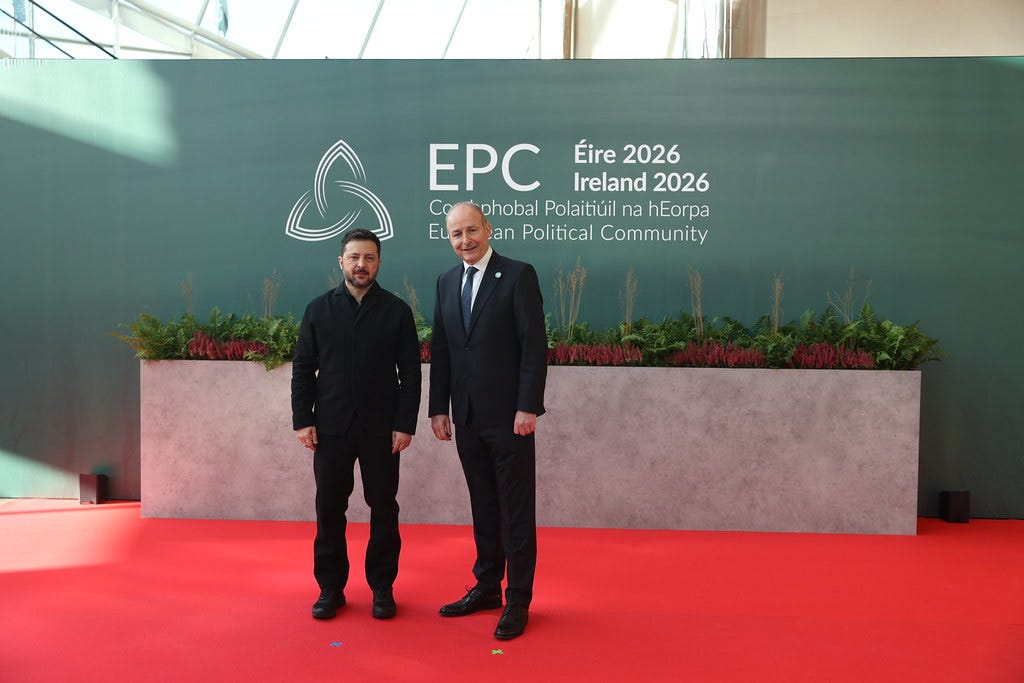
You’ll hear that phrase a lot in the coming weeks. Prime Minister Mark Carney was in Dublin too, among some 50 leaders at the European Political Community summit. When he hosted Zelensky in Calgary in September, Carney reaffirmed Canada’s support for Ukraine’s territorial integrity.
It sounds like diplomatic boilerplate. It isn’t. As peace talks come back to life, those two words have become the biggest obstacle to ending the war, and the clearest signal of where each leader stands.
Here’s a guide to what’s happening, and why it matters.
Peace talks are back
This week, for the first time since February, negotiators from Ukraine, Russia and the U.S. sat down together in Abu Dhabi. U.S. envoys Steve Witkoff and Jared Kushner then flew to Moscow to see Vladimir Putin, and on to Dublin to brief Zelensky.
The concrete result was modest but real: agreement on what Kushner called the biggest prisoner-of-war exchange of the war. He also said Europeans will join the next round. “We cannot conclude this deal without the Europeans being at the table,” he told reporters in Dublin, according to RTÉ’s Tony Connelly.
The tantalizing part came before the talks began. A U.S. official told Reuters that both Moscow and Kyiv were privately showing some flexibility on a possible exchange of territory. In public, neither side budged. Russia’s negotiator, Vladimir Medinsky, said territorial exchanges were out of the question, Radio Free Europe/Radio Liberty (RFE/RL) reports, and Ukraine’s Rustem Umerov said significant differences remain.
Why two words matter so much
Russia occupies about 20 per cent of Ukraine, including Crimea and much of the Donbas region in the east. Putin wants all of the Donbas, including the part his army hasn’t captured. Ukraine wants Russia pushed back to its internationally recognized borders.
When a leader says “territorial integrity,” they’re signalling which side of that gap they stand on. Taken literally, it means no deal until Russia hands back land it hasn’t lost on the battlefield and has no intention of returning.
Zelensky said in Dublin that U.S. negotiators “very often raise” the Donbas. His answer, per the Kyiv Post: “It’s impossible to talk this way with us, with an independent, sovereign country.”

What is a war of attrition?
Since Ukraine’s 2023 counteroffensive stalled, which I wrote about in January 2024, the front line has barely moved. This is a war of attrition. Neither side can break through, so each tries to wear the other down in soldiers, shells and money, until one can’t continue.
On paper, that favours Russia. It has more than three times Ukraine’s population and an economy on a war footing. But Western officials now say Russia’s losses outpace its recruits by about 6,000 a month. So both sides believe time is on their side, and that’s exactly the kind of war that grinds on for years.
The terrible arithmetic
The Center for Strategic and International Studies (CSIS), a Washington think tank, estimated combined Russian and Ukrainian casualties (killed, wounded and missing) at up to 1.8 million by the end of 2025, on track to pass two million this year. Between 375,000 and 465,000 soldiers have been killed.
The UN has verified at least 16,874 civilian deaths since February 2022, including 820 children, and the true number is almost certainly higher. This July was the deadliest month for civilians since the first weeks of the invasion.

Who will do the fighting?
Earlier this month, about 100 protesters threw rocks and eggs at a National Guard building near Kyiv after rumours spread online that new recruits were being tortured inside. As Reuters’ Dan Peleschuk told CBC’s Front Burner, the torture claims appear to have been manufactured, and Russia was quick to exploit them. The anger, though, was real.
Ukrainians call it “busification”: recruitment crews pulling military-age men off streets and buses and taking them straight to enlistment centres. In January, then-defence minister Mykhailo Fedorov said about two million Ukrainians were wanted for draft evasion and 200,000 soldiers had gone absent without leave. Ukraine’s whole army is roughly one million strong.
Yet Ukrainians are not giving up. A poll by the Kyiv International Institute of Sociology (KIIS) this summer found 60 per cent oppose handing the Donbas to Russia. Here’s the twist: 59 per cent would also accept freezing the war along the current front line in exchange for security guarantees, most of them reluctantly.
Principle versus price
So Ukrainians themselves seem to be drawing a line their allies won’t say aloud. Refusing to surrender land is one thing. Fighting on indefinitely to take it back is another.
Sitting here in Canada, this is hard to judge. If Canada were invaded, I might feel very differently. Ukraine was attacked, and international law is on its side.
But there may be a better way to honour the principle, and Canada has done it before. For half a century, Canada refused to recognize the Soviet Union’s 1940 annexation of Estonia, Latvia and Lithuania. No war was fought to reverse it. When the Soviet Union collapsed, the Baltic states walked back into independence, and the legal claim was waiting for them.
Ukraine’s territorial integrity can be defended the same way: a ceasefire along the current line, firm security guarantees for Ukraine, and a permanent refusal to recognize Russia’s annexations. That’s the position Canada should carry to the table.
So, where would you draw the line?
If you found this interesting or informative, please like or share.
Leave a comment to explain your vote (paid subscribers)
Last week’s polls: what you told me
Thank you to everyone who voted. Here’s what you shared.
Is Remembrance Day too much about war, and not enough about peace? Fully 85 per cent said yes, it needs more focus on peace. Eight per cent said the balance is about right, 4 per cent said the focus should stay only on those who served, and 3 per cent said the day has lost its meaning for many.
Should Canada’s new defence purchasing law include environmental safeguards? You were close to unanimous. Fully 90 per cent said yes, with strict, enforceable rules. Another 6 per cent backed safeguards as long as they don’t slow down production, and 3 per cent said defence needs come first. Not one reader thought provincial rules were enough.

