


The Canadian government has avoided commenting on the United States’ controversial targeting of alleged drug-trafficking vessels in Caribbean waters.
Meanwhile, the U.S. ratchets up its war rhetoric against oil-rich Venezuela, and Canada’s Navy cooperates with U.S. forces in the volatile region.
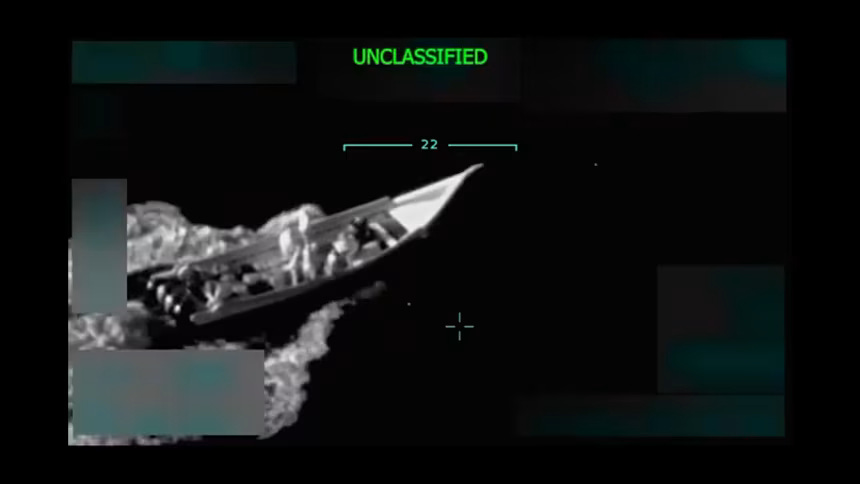
“I would say it is within the purview of U.S. authorities to make that determination,” Canada’s Foreign Affairs Minister Anita Anand said in response to a reporter’s question asking whether the U.S.’s shoot-first-ask-questions-later attacks are war crimes.
Since September 2, U.S. Air Force planes have blown up twenty-one-and-counting vessels in those same waters, killing at least eighty people. Without offering evidence, U.S. President Trump claimed the boats were smuggling drugs into the U.S.
U.S. build-up biggest since 1960s Cuban Missile Crisis
President Donald Trump has ordered an unprecedented military deployment of Navy forces off the Venezuelan Coast.

The Gerald R. Ford Carrier Strike Group, including the flagship aircraft carrier USS Gerald R. Ford, its assigned air wing of F/A-18E/F Super Hornets, and the destroyers USS Winston S. Churchill, USS Mahan, and USS Bainbridge, is operating alongside a U.S. Air Force B-52 Stratofortress, reports Newsweek.
Canada’s Navy has been active in the region, too, in what is dubbed “Operation CARIBBE,” a multinational force led by the U.S. Coast Guard.
Ottawa Citizen reporter David Pugliese says the Canadian military is a major player in U.S.-led counterdrug operations in the Caribbean with Royal Canadian Navy ships and Royal Canadian Air Force long-range patrol planes playing a role.
Canada sharing targeting information with Americans
Canadian warships find and track vessels of interest at which point U.S. Coast Guard law enforcement teams then approach and intercept them, according to the Canadian government. RCAF CP-140 Aurora aircraft and their crews also detect and track vessels and aircraft of interest.
National Defence, however, has not halted its information-sharing in Operation CARIBBE, say Stephen Kimber and John Kirk in The Walrus.
“What guarantees does Canada have that the U.S. Coast Guard won’t share our spotting data with the U.S. Air Force, which it can then use to bomb suspect vessels?” they ask.
“Kill everybody” double-tap attack
U.S. War Secretary Pete Hegseth, following the first striking of a boat in the Caribbean in September, issued a verbal directive to American service members to “kill everybody” with a second strike that would leave no survivors, according to a new report from the Washington Post. The secretary strongly refutes such claims.
If true, such an attack would violate international laws preventing attacks against combatants who no longer pose a threat, such as prisoners, considering it akin to extrajudicial executions.
As one commentator put it, Russian troops accused of killing Ukrainian prisoners taken in combat are being tried in the International Criminal Court, but here we have an example of the United States doing what amounts to the same thing.
Canadian human rights groups urge Canada to take action
Common Frontiers and the Americas Policy Group sent a letter last month to Foreign Affairs Minister Anand and other ministers calling on the Canadian government to use all diplomatic means to publicly condemn and call for a halt to U.S. airstrikes on civilian boats in Latin America and the Caribbean.

The human rights groups also urge Canada to suspend Operation CARIBBE and its Memorandum of Understanding with the U.S. to avoid any risk of Canadian intelligence being used in unlawful, lethal attacks.
Canada’s government has shown no inclination to take either diplomatic or military measures, despite the controversy over Secretary Hegseth’s purported command to kill survivors, and other countries such as the U.K. halting intelligence-sharing with U.S. forces in the region.
As The Hill Times points out, Canada’s Foreign Minister’s comments deflecting an opinion on potential war crimes is a departure from previous instances where Canada has alleged foreign countries have committed international law violations. For instance, last month Minister Anand was one of more than a dozen signatories to a joint statement, “condemning atrocities and violations of international humanitarian law in Sudan.”
Leave a comment to explain your vote
Most readers disbelieve Canada will join Trump’s Golden Dome
Last week’s newsletter shared an estimate that Trump’s Golden Dome plan will require 250,000 space weapons. Despite the Prime Minister’s commitment to Trump that Canada will join Golden Dome, a majority readers think PM Carney’s commitment won’t be fulfilled.
More than half (53%) says “No, its just for show,” while one third say they don’t know or are unsure. A minority say Carney will join if he thinks it will help Canada’s economy (15%).
Comments from readers:
“The golden dome is the most scary, most wasteful and most destructive idea ever.” - Hanny
“For Carney, helping “our” economy means the fortunes of the 1%, and it seems that is his only guiding star, whatever the collateral damage.” – B. Stuart
“I hope this is just a show for Trump, but I am by no means confident of this.” – J. Carmichael

I can't see Canada explicitly condemning the wanton killing of sailors, who might or might not be rug runners. We are too deeply enmeshed with US forces, unfortunately. It would be good though if Canadas at least quietly withdrew from operation CARRIBE. And over the long term we need to distance our defense strategy. The Venezuelan target is pute imperialism- US want the heavy crude.
I don't think Carney has the guts to do it. Although he would probably say that behind the scenes diplomacy is more effective. He might even be right about that. But it hurts that he won't condemn what even some (retired) military authorities in the States say amounts to nothing more than mass murder.