


It started, in part, with a TV show. Sky News aired The Wargame, a drama in which Britain comes under attack from at Russia, and retaliates against the Russian enclave of Kaliningrad.
That’s when Moscow responded, for real.

Russia’s embassy in London threatened the West with nuclear war if it attacks the Kremlin’s European outpost of Kaliningrad, according to the UK’s Daily Mail.
The warning, posted on the embassy’s social media channels, responded to a TV show that aired last week and depicts a fictional scenario in which Russia attacks the UK. In the drama, the British prime minister orders a retaliatory attack against the Russian territory of Kaliningrad.
“Those advocating plans to blockade or strike Kaliningrad should have no illusions about the consequences,” said the Russian Embassy post on Telegram. “Any British or NATO military action against Russian territory would be met with a response using all means at Russia’s disposal, including nuclear weapons.”
On Wednesday, NATO confirmed it had also received a written warning from Moscow. According to the note, obtained by Reuters, Russia “will be ready to use the entire arsenal of forces and capabilities at its disposal, including nuclear weapons” if NATO tries to cut off Kaliningrad.
NATO says no blockade is planned. But Canadians should pay attention. Canada leads NATO’s multinational brigade in Latvia, a few hundred kilometres away, with about 2,200 troops committed there.
What is Moscow saying?
The note capped a week of warnings from Russian embassies in London, Paris and Dublin. It went further than past rhetoric, raising the prospect of “strikes against decision-making centers” — diplomatic language for hitting capitals. A senior European defence official told Reuters it was the first threat of its kind since the Cold War.
Kremlin spokesman Dmitry Peskov told reporters that diplomats were simply reminding “the hotheads in Europe” of Russia’s policy documents. In 2024, Putin signed a new nuclear doctrine that lowered the bar for using nuclear weapons, including in response to a conventional attack.
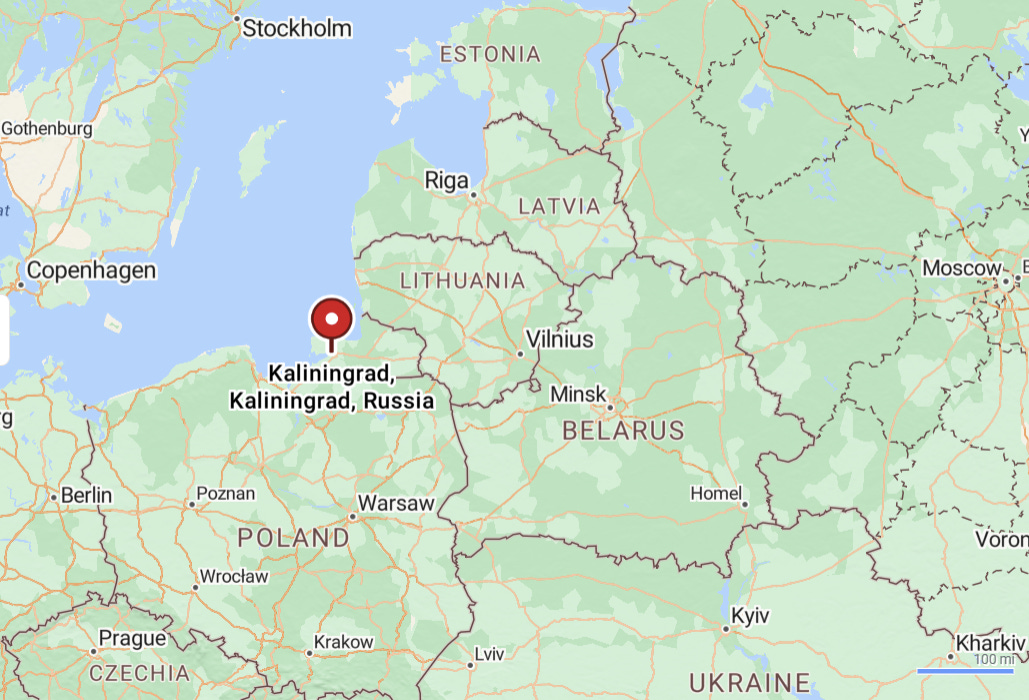
Why Kaliningrad?
Until 1945, Kaliningrad was the German city of Königsberg, home of the philosopher Immanuel Kant. The Red Army captured it, Stalin renamed it, and its German residents were expelled. When the Soviet Union collapsed, the territory was stranded between Poland and Lithuania, both NATO members since 2004. Today it hosts Russia’s Baltic Fleet and nuclear-capable Iskander missiles, and it sits beside the Suwałki Gap, the narrow land corridor linking the Baltic states to the rest of NATO. For Moscow, it is both a forward fortress and its most exposed flank.
Reaction from NATO and Europe
NATO spokesperson Allison Hart denounced “any irresponsible nuclear rhetoric” and said none of NATO’s exercises “pose a risk to any part of Russia.” Secretary General Mark Rutte sees the threats as a sign Putin is losing.
Not everyone agrees. John Lough, a former Moscow-based NATO official, told The Independent:
“Putin thinks he’s winning, and I think he’s right.”
Others want to hit back harder. EU Defence Commissioner Andrius Kubilius said Putin “needs to feel that war is coming to Russia itself.” Bulgaria’s Prime Minister Rumen Radev was a rare voice urging diplomacy.
An arms race on both sides
None of this comes out of nowhere. In 2023, Putin moved tactical nuclear weapons into Belarus, saying Russia was “doing what they [the U.S. and NATO] have been doing for decades,” referring to the U.S. stationing of nuclear bombs in five European countries. Last December, Russia showed off its new Oreshnik missile deployed in Belarus.
NATO has escalated too. U.S. nuclear weapons have reportedly returned to Britain for the first time since 2008. In March, France announced more warheads and plans to station nuclear-capable jets in eight allied countries, including Poland.
Meanwhile, New START, the last treaty limiting U.S. and Russian arsenals, expired in February. For the first time in decades, no treaty caps the world’s two largest nuclear arsenals.
What Canada should do next
As someone who has spent decades working on disarmament, I don’t think the answer to a nuclear threat is a bigger one.
Canada has a voice here. It sits on NATO’s Nuclear Planning Group, and it has a history of choosing diplomacy: Pierre Trudeau’s 1983 peace initiative and the removal of the last U.S. nuclear weapons from Canadian soil in 1984. Ottawa should press NATO to set up a military hotline and incident rules in the Baltic, reopen talks on intermediate-range missiles in Europe, and oppose new nuclear deployments on either side.
So, should Canada echo NATO’s tough talk, or lead the push to lower the temperature?
If you found this interesting or informative, please like or share.
Leave a comment to explain your vote (paid subscribers)
Last week’s readers’ poll
Last week we reflected on Prime Minister Carney’s interview with the New York Times where he revealed that he has studied the possibility of U.S.-led military action against Canada. I asked you and other readers how seriously should Canada take the risk of U.S. military action?
Nearly a one-in-ten (29%) said very seriously: let’s prepare now, while half of readers took a bit more tempered view: the chance is remote, but worth planning for (49%). More than one-in-ten (13%) felt the real threat is economic, not war.
