


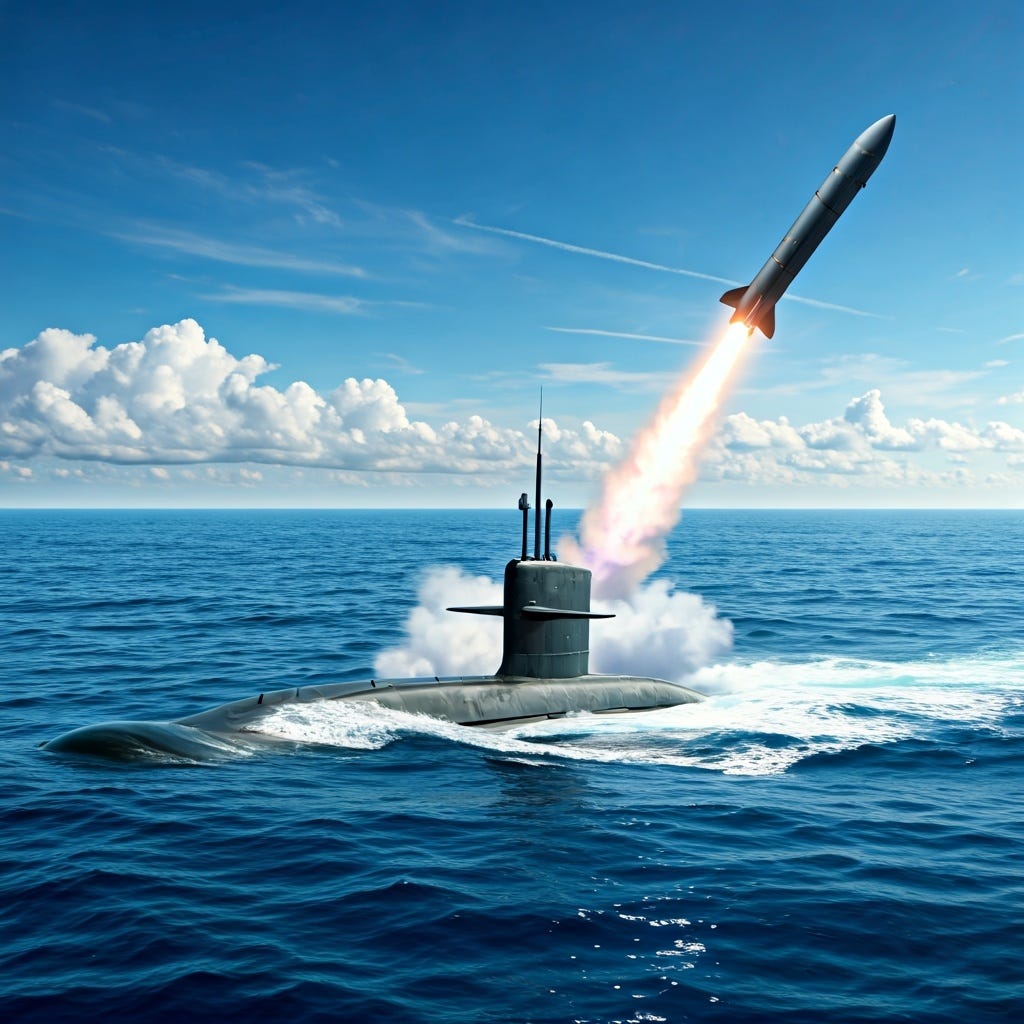
Lurking beneath the surface of the debate about Canada’s new submarines is the power to attack other countries using cruise missiles.
A thorough media scan reveals practically no discussion about this important escalation, which would put Canada among only a few Western navies (the United States, the United Kingdom, and France) that operate submarine-launched land-attack weapons.
Dr. Peter Jones of the University of Ottawa, who served as senior analyst for the Security and Intelligence Secretariat of the Privy Council of Canada, writes that Canada is on the cusp of a major military transformation by adding cruise missiles to its submarine fleet.
“Are we ready for this?” he asks, writing in The Walrus. “Do we understand that with this capability comes an expectation from allies and adversaries alike that we will be prepared to use it?”
The Royal Canadian Navy (RCN) is preparing to replace its fleet of four aging Victoria-class submarines, which were themselves second-hand British vessels with a troubled operational history, with up to twelve new, state-of-the-art submarines. It will be the most expensive military program in Canadian history, with a cost estimate of $100-billion – a price tag that could dwarf the cost of new fighter jets, such as the F-35.
This development comes amid a broader defence spending increases, with Canada aiming to meet NATO targets by raising defence expenditures from $30.9 billion annually to potentially $150 billion by 2035, which will support a larger, modernized military.
Vice Admiral Angus Topshee, commander of the RCN, has openly acknowledged a “very unCanadian capability” in the submarines’ ability to stealthily threaten adversaries, signalling a departure from Canada’s historically defensive and peacekeeping military posture toward a more assertive, power-projection role.
But where is the public discussion about the role of Canada’s submarines and the Navy’s ambitions to add cruise missiles to its arsenal?
Documents outlining the desired characteristics of potential new submarines make no mention of land-attack cruise missiles, according to media reports. The government has narrowed the contest down to two submarine-builders, one based in Germany and the other in South Korea.
A general online review of the two submarines suggests Canada’s choice is between a submarine intended for highly covert Arctic patrols, intelligence gathering, and deterrence in contested northern passages (Germany’s Type 212CD built by TLMS), and one for strategic reach across the Pacific and Atlantic (South Korea’s KSS-III built by Hanwha).

I alerted Canadian Senators that tough questions need to be asked about the submarine program when I presented to a Senate committee last Fall. “While the submarines could be used in the Arctic, their real point is as an offensive system, not a defensive one.”
Prime Minister Mark Carney wants to move quickly on the purchase of the new fleet and government officials have said the plan is to have a contract in place sometime early this year.
As Peter Jones says, “The subs are only the beginning. We are preparing to pour unprecedented sums into our armed forces.”
Canadians deserve to have a voice in this important decision that will affect our and future generations.
Most readers think more Liberal MPs will break ranks
Just before the holidays, PeaceQuest looked at growing unease among Liberal MPs about the policy direction of the Carney government. For example, former Environment and Climate Change Minister Steven Guilbeault stepped down from Cabinet after the pipeline agreement with Alberta was announced.
A small majority of readers (53%) agreed that more Liberal MPs will protest PM Carney’s rightward drift in 2026, while nearly a third said they didn’t know or were unsure (30%).


