


Amid the gloom and bad news, occasionally you might find a glimmer of hope.
For years people in Canada who support nuclear disarmament have been disheartened by Canada’s disinterest in the UN Nuclear Ban Treaty, more widely know by its official United Nations title, “The Treaty on the Prohibition of Nuclear Weapons,” or TPNW.
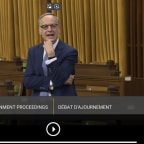
But recently Canada’s Parliamentary Secretary to the Minister of Foreign Affairs Rob Oliphant said something in Parliament that caught the ear of former Ambassador for Disarmament, Senator Doug Roche (ret.).
“This afternoon in the House of Commons, Rob Oliphant, Parliamentary Secretary for Foreign Affairs, responding to Elizabeth May’s advocacy, said he personally agreed with her that Canada should send an Observer Delegation to the upcoming meeting of states parties to the TPNW. and would argue for this with his colleagues,” said Roche.
“I wouldn’t call this the greatest breakthrough in the world, but it is certainly an advance when an official of the government speaks in the House on the value of the TPNW and says he will argue that Canada send an official delegation to the upcoming meeting.”

Peace groups have seized upon MP Oliphant’s comments, encouraging him to convince the government to support the TPNW, or at least attend its next official meeting in March at the United Nations.
What is the Nuclear Ban Treaty?
The 2017 treaty is the arguably the first legally binding international agreement to comprehensively prohibit nuclear weapons, with the ultimate goal being their total elimination.
The International Campaign to Abolish Nuclear Weapons (ICAN), the non-governmental group that championed the treaty and won the Nobel Peace Prize for its efforts, says the agreement fills a significant gap in international law.
“It prohibits nations from developing, testing, producing, manufacturing, transferring, possessing, stockpiling, using or threatening to use nuclear weapons, or allowing nuclear weapons to be stationed on their territory. It also prohibits them from assisting, encouraging or inducing anyone to engage in any of these activities,” as their website describes it.
As of September 2025, 74 states have ratified the treaty, most recently Ghana.
Why does NATO oppose the Nuclear Ban Treaty?
The transatlantic military alliance of NATO relies on nuclear weapons as part of its military strategy. Three NATO states have nuclear weapons (the U.S., the U.K. and France), and five others have American nukes based in their countries.
“NATO has long maintained a strong unified position in opposition to the new treaty, meaning that under current circumstances it is unlikely that any NATO member will join the TPNW,” writes Steven Hill. “But the reality for NATO, its members and partners is that the TPNW is now here to stay.”
Where does Canada fit in?

Like a man with a proverbial foot on the dock and a foot in the canoe, Canada has been opposed to the Nuclear Ban Treaty while saying it supports the abolition of nuclear weapons.
Hiroshima survivor Setsuko Thurlow and Bianca Mugyenyi say Ottawa’s opposition to the prohibition treaty appears driven by the military and political establishment’s ties to the United States and NATO.
“Initially Prime Minister Trudeau dismissed the UN conference that negotiated the treaty, stating, ‘there can be all sorts of people talking about nuclear disarmament, but if they do not actually have nuclear arms, it is sort of useless.’ As support for the TPNW has solidified, the government’s tone softened.”
Canadians haven’t given up
Nearly ten years later, many Canadians still want Canada to join the Nuclear Ban Treaty. This year a group of citizens based on Vancouver Island called Peace Train Canada, with the support of NDP MP Gord Johns travelled across Canada and to the United Nations urging Canada to sign the treaty.
What you can do
Take a moment to send a personal note to Parliamentary Secretary for the Minister of Foreign Affairs Rob Oliphant and encourage him to attend the upcoming meeting of countries who support the Treaty on the Prohibition of Nuclear Weapons.
His Ottawa email address is rob.oliphant@parl.gc.ca
Keep me posted of any replies to your letter you might receive.
Leave a comment explaining your vote.
Readers not hopeful PM Carney will take action on Caribbean conflict
Last week we looked at the risk of Canada being dragged into the U.S.-led conflict with Venezuela, where U.S. forces continue to attack alleged drug-smuggling boats and most recently seized an oil tanker. Many have said some of the actions break international law, amounting to war crimes.
Unfortunately, most readers think Prime Minister Carney will remain quiet. Three out of four (74%) said PM Carney won’t take action to prevent U.S. war crimes in the Caribbean.
Readers’ comments:
“I can’t see Canada explicitly condemning the wanton killing of sailors, who might or might not be drug runners. We are too deeply enmeshed with U.S. forces, unfortunately.” - S. Walke
“I don’t think Carney has the guts to do it. Although he would probably say that behind the scenes diplomacy is more effective.” - S. Craig


