


CBC’s Front Burner just dropped part two of its documentary on Mark Carney’s defence buildup, and if part one was about the gold rush inside CANSEC, part two is about where all that gear is actually headed.
Producer Imogen Birchard opens with something worth sitting with: Carney’s entire pitch for this buildup rests on the idea that the United States is now a danger to Canada.
“They want our land, our resources, our water, our country,” he’s said. That’s the justification for spending so much, and for spending it here at home rather than sending it south.
But as NATO’s Secretary General Mark Rutte cheerfully reminded a summit last year — while calling Trump “daddy,” of all things — none of this 5%-of-GDP spending spree would be happening without Trump pushing for it in the first place.
Buy Canadian, sort of
Ottawa Citizen defence reporter David Pugliese lays out the fact that roughly 70 cents of every capital defence dollar currently goes to American companies. The Defence Industrial Strategy wants to flip that so 70% goes to Canadian firms instead. Good luck.
The F-35 fighter aircraft saga shows how hard that flip actually is — Carney ordered a review, and the U.S. ambassador reportedly started making threats about what happens if Canada doesn’t buy the planes, while retired Canadian generals with ties to U.S. contractors kept showing up in the media pushing for them anyway.
This month, Canada also confirmed a $2.6-billion direct purchase of 26 HIMARS rocket launchers from the U.S. government – a controversial weapon system of the type Canada has never owned, and can deliver devastating cluster bombs.
Project Ploughshares researcher Kelsey Gallagher points out that five of Canada’s top ten arms manufacturers are American branch plants operating in Canada — General Dynamics, Lockheed Martin, L3Harris among them.
When Defence Minister David McGuinty announced $1.4 billion for domestic ammunition production this spring, most of it went to a Quebec subsidiary of General Dynamics – a U.S.-owned company. Former Conservative leader Erin O’Toole, put it well at when asked about the deal at CANSEC. He said, a wholly-owned American subsidiary isn’t what “Canadian” is supposed to mean.
The path of least resistance
Here’s the part that should worry every PeaceQuest reader – it’s what I have described as Carney’s plan’s fatal flaw.
The strategy’s other big goal is growing arms exports by 50% — Gallagher calls it the most aggressive export increase in Canadian history. And given how integrated our defence industry already is with the U.S., he expects most of that growth to flow along the path of least resistance: south of the border, to the one buyer that’s already there.
Which matters, because Gallagher’s research found an Ontario-built L3Harris camera system was used to track boats in at least two of the U.S. military’s strikes in the Caribbean this year — strikes that have killed over 200 people and that human rights monitors have called extrajudicial killings.
Canada has given up a say in any of this. Because of the “long-standing” defence trade relationship with Washington, the vast majority of arms transfers to the U.S. move without a permit and without a human rights risk assessment — despite Canada’s obligations under the UN Arms Trade Treaty. An NDP bill to close that gap, the No More Loopholes Act, was opposed by the government (Foreign Affairs Minister Anita Anand called it “irresponsible”) and failed, even after 15 Liberal MPs broke rank to support it.
Where the parts really end up
The indirect transfers of weapons to third countries are just as troubling. Canada paused new arms export authorizations to Israel back in January 2024. But Canadian-made components — worth roughly $3 million per aircraft — still reach Israel anyway, built into F-35s sold by Lockheed Martin in the U.S. and used throughout the bombardment of Gaza. As Gallagher puts it, a wingtip might seem less dangerous than a rifle, but an F-35 can’t fly a strike on Gaza without its constituent parts.
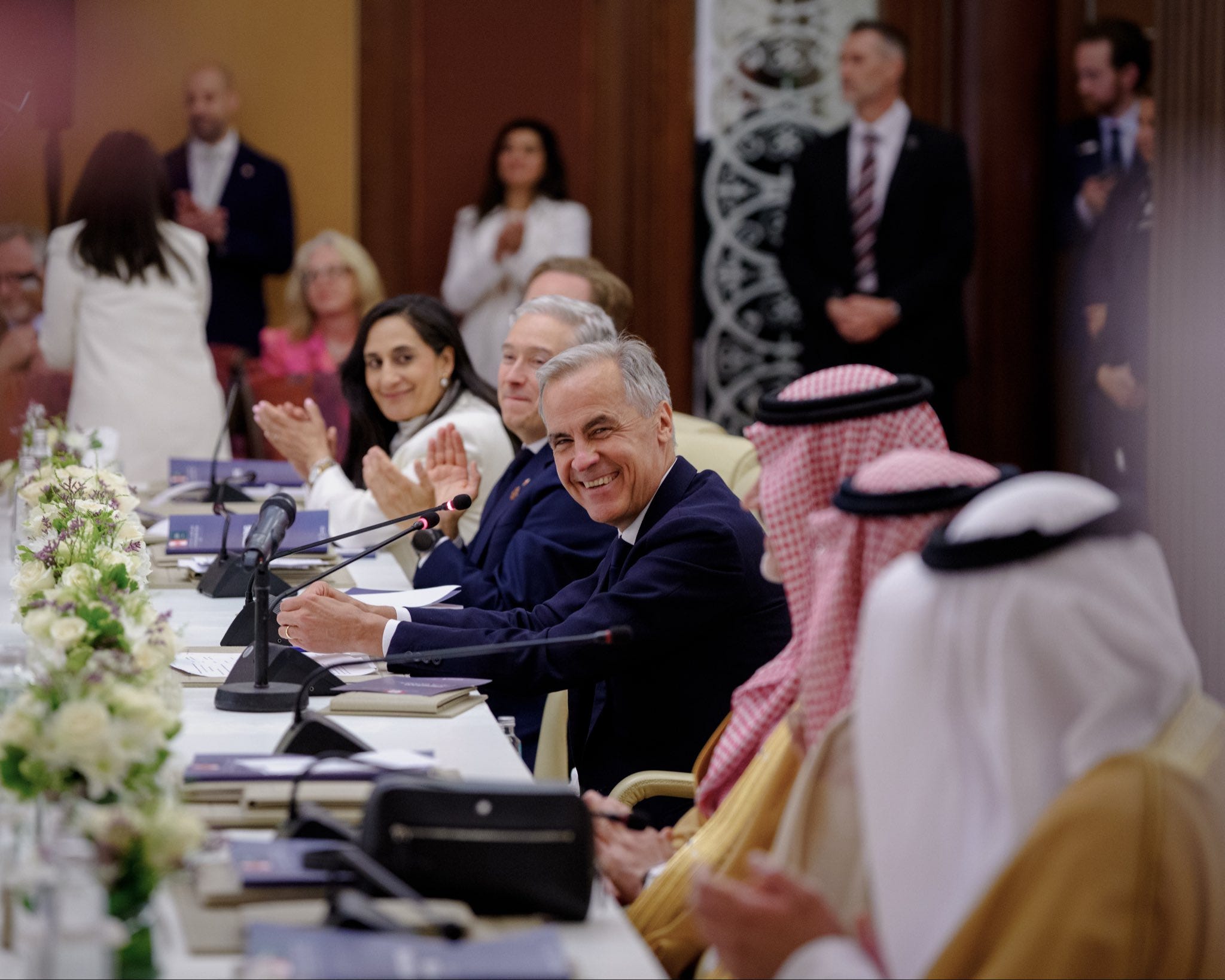
And then there’s Saudi Arabia, the second-largest recipient of Canadian arms after the U.S.: $1.3 billion in 2024, mostly Canadian made light armoured vehicles tied to the 2014 contract — the largest arms deal in Canadian history. That relationship traces back to the 1990s, when a U.S.-owned plant in London, Ontario needed a new customer after U.S. Army orders dried up.
Justin Trudeau’s government talked about getting out of the deal after the Yemen war and the murder of Jamal Khashoggi, but backed off once it became clear cancelling would trigger massive penalties. A 2020 government review concluded, almost unbelievably, that these exports “contribute to regional peace and security.” Later that year, a UN panel found Canada was helping fuel the war in Yemen. The exports continued anyway.
The value of our strength
Carney closed his CANSEC speech with a line he’s clearly fond of: “Canada will be defined not only by the strength of our values but also the value of our strength.” It’s a good line. It’s also the whole question this documentary is really asking.
As Canada chases 125,000 new defence jobs and a 50% jump in arms exports, what happens when keeping those jobs “long-term and stable” means finding buyers who’ll keep the production lines running — values or no values? Once you’ve built a defence economy, as one voice in the episode notes, you need your product to be used. History suggests we already know what that trade-off looks like.
If part one was about the gold rush, part two is about the bill that always comes due. Worth the 25 minutes.
Listen to Front Burner, part two: Canada’s massive military buildup: Part 2
Listen to last week’s Part 1, if you missed it.
If you found this interesting or informative, please like or share.
Leave a comment to explain your vote (paid subscribers)
Readers believe Carney’s promise to quadruple military spending
Last week we dove into Carney’s defence strategy and I asked you, “Do you believe PM Carney when he promises to quadruple military spending to $150 billion?”
Most people said yes, they believe this is Mark Carney’s plan (52%), but one quarter agreed with the caveat that things could change (28%). A small number (16%) felt PM Carney was just trying to appease Trump, suggesting he may not go through with the military build-up he’s announced.

None of the above. It is only being done because it is not yet a capital offense to make money from war, and is often very profitable. Outlaw private wealth to get a true civilization.
Carney is using the pretence of "defence" to create a war industry based on the assumption that it will give a spur to the economy. The fact is that these investments are enhancing U.S. companies' profits while starving Canadians of essential social services, such as expansion of denticare and pharmacare. Carney and the Liberal Party are continentalists ideologically—junior partners to American imperialism. The term "defence" is a euphemism for destructive war production—destructive to humans, particularly in countries that the American capitalists want to dominate—and it's a term that principled critics should disdain. It's war profiteering and it is violence against human beings and the earth system.